Bipartite networks¶
Flow model
At a glance
A bipartite network has two node types with links only between them. Declare
the boundary with bipartite_start_id and Infomap models the alternating
random walk directly, returning modules that mix both node types.
Two node types, links between them¶
Many networks connect two distinct kinds of entities: users rating movies, species visiting flowers, authors writing papers. Links go exclusively between the two types, never within them. This is a bipartite network.
A common workaround is to project one type onto the other, replacing user–item links with user–user links whenever two users share an item. The projection densifies the network and conflates distinct interaction patterns into weighted cliques. Running Infomap on the bipartite network itself avoids that loss: the walk alternates between the types, and the communities keep both types together.
How Infomap handles the two types¶
You assign integer node ids so that all type-A nodes come first and all
type-B nodes start at a threshold id, and declare that threshold by setting
bipartite_start_id. Infomap then models the alternating walk with a
two-step encoding: each move A → B → A counts as one step between type-A
nodes, and by default the type-B nodes’ visit rates are folded onto the
type-A side. The codelength therefore describes the flow among the type-A
nodes, with the type-B nodes acting as the contexts that route it. Both
types still receive module assignments.
Which type goes first?
Put the nodes whose communities you care about below the threshold: their
flow is what the code describes. If you also write native output files with
the stateful Infomap, hide_bipartite_nodes=True drops the
other type from those files (it does not filter the in-memory
Result).
Two engine options change this treatment, passed via
Options (e.g. run(net, options=Options(skip_adjust_bipartite_flow=True))):
skip_adjust_bipartite_flow=True keeps flow on the type-B nodes so both types
are coded, and bipartite_teleportation=True makes a directed run teleport with
bipartite-aware jumps instead of the default two-step unipartite scheme.
Users and items in shared clusters¶
The scenario: four users and four items. Users 0 and 1 strongly prefer items 4 and 5; users 2 and 3 strongly prefer items 6 and 7. A few weak cross-cluster links add noise. We would like Infomap to recover the two preference clusters, each containing two users and two items.
Set up the network¶
import infomap
from infomap import Network, run

# Node-id convention:
#   Users  → ids 0, 1, 2, 3         (type A: "left")
#   Items  → ids 4, 5, 6, 7         (type B: "right")
#
# All type-B ids must be >= BIPARTITE_START.
BIPARTITE_START = 4

net = Network()

# Declare the bipartite boundary: everything from id 4 onwards is type B.
net.bipartite_start_id = BIPARTITE_START

# Cluster 1: users {0,1} prefer items {4,5}
net.add_link(0, 4, 3.0)
net.add_link(0, 5, 2.0)
net.add_link(1, 4, 2.0)
net.add_link(1, 5, 3.0)

# Cluster 2: users {2,3} prefer items {6,7}
net.add_link(2, 6, 3.0)
net.add_link(2, 7, 2.0)
net.add_link(3, 6, 2.0)
net.add_link(3, 7, 3.0)

# Weak cross-cluster signal
net.add_link(0, 6, 0.2)
net.add_link(2, 4, 0.2)

print(f"Bipartite start id: {net.bipartite_start_id}")
print(f"Nodes with id >= {BIPARTITE_START} are treated as type-B (items).")
Bipartite start id: 4
Nodes with id >= 4 are treated as type-B (items).
Run and inspect modules¶
result = run(net, two_level=True, num_trials=10, seed=123)

modules = result.modules()   # {node_id: module_id}

print(f"Bipartite start id:      {net.bipartite_start_id}")
print(f"Top-level modules found: {result.num_top_modules}")
print(f"Codelength (bits/step):  {result.codelength:.4f}\n")

for node_id, module_id in sorted(modules.items()):
    kind = "user" if node_id < BIPARTITE_START else "item"
    print(f"  node {node_id:2d} ({kind:4s})  →  module {module_id}")
Bipartite start id:      4
Top-level modules found: 2
Codelength (bits/step):  1.2798

  node  0 (user)  →  module 1
  node  1 (user)  →  module 1
  node  2 (user)  →  module 2
  node  3 (user)  →  module 2
  node  4 (item)  →  module 1
  node  5 (item)  →  module 1
  node  6 (item)  →  module 2
  node  7 (item)  →  module 2
Each module mixes the two types: users {0, 1} group with items {4, 5}, and users {2, 3} with items {6, 7}, even though no user–user or item–item links exist.
With and without the declaration¶
Declaring the boundary changes the flow model, not the data. Run the same
links without setting bipartite_start_id, and Infomap treats them as an
ordinary unipartite network instead:
net_std = Network()
for u, v, w in [
    (0, 4, 3.0), (0, 5, 2.0), (1, 4, 2.0), (1, 5, 3.0),
    (2, 6, 3.0), (2, 7, 2.0), (3, 6, 2.0), (3, 7, 3.0),
    (0, 6, 0.2), (2, 4, 0.2),
]:
    net_std.add_link(u, v, w)
result_std = run(net_std, two_level=True, num_trials=10, seed=123)

print(f"unipartite run: {result_std.num_top_modules} modules, L={result_std.codelength:.4f}")
print(f"bipartite run:  {result.num_top_modules} modules, L={result.codelength:.4f}")
unipartite run: 2 modules, L=2.1591
bipartite run:  2 modules, L=1.2798
The two codelengths are not directly comparable, because the runs describe different walks: the bipartite run codes only the two-step flow between users, the unipartite run codes every node. On this small network both find the same two clusters; on larger networks the declaration changes the flow each node carries and can move module boundaries.
Visualise¶
Lay the two node types out as two columns, users on the left and items on the right, so the community structure reads as horizontal bands.
import matplotlib.pyplot as plt
from myst_nb import glue

import networkx as nx
from docs_viz import draw_partition

# Build a NetworkX graph matching the Infomap network above
G = nx.Graph()
G.add_nodes_from(range(8))
for u, v, w in [
    (0, 4, 3.0), (0, 5, 2.0), (1, 4, 2.0), (1, 5, 3.0),
    (2, 6, 3.0), (2, 7, 2.0), (3, 6, 2.0), (3, 7, 3.0),
    (0, 6, 0.2), (2, 4, 0.2),
]:
    G.add_edge(u, v, weight=w)

# Two columns: users left, items right. The default bipartite run folds item
# flow onto the users, so items would draw as near-invisible dots if sized by
# flow; size every node the same and let colour carry the module structure.
pos = {u: (0.0, 3 - u) for u in range(4)}
pos.update({v: (2.2, 3 - (v - 4)) for v in range(4, 8)})

fig, ax = plt.subplots(figsize=(5.4, 4.2))
draw_partition(G, modules, ax=ax, pos=pos, with_labels=True, node_size=620)
ax.text(0.0, 3.7, "users", ha="center", color="0.35", weight="bold")
ax.text(2.2, 3.7, "items", ha="center", color="0.35", weight="bold")
ax.set_xlim(-0.6, 2.8)
ax.set_ylim(-0.6, 4.0)
fig.tight_layout()
glue("fig-bipartite", fig, display=False)
plt.close(fig)
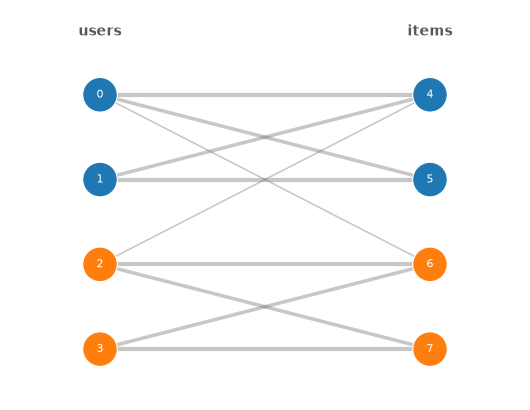
Fig. 13 The bipartite network as two columns, users on the left and items on the right, coloured by module. Each module is a band spanning both types: users {0, 1} with items {4, 5}, users {2, 3} with items {6, 7}. The thin diagonals are the two weak cross-cluster links.¶
API pointers¶
Declare the split by setting bipartite_start_id (or
bipartite_start_id) before running, and link opposite
types with add_link(); modules()
covers both types. The bipartite engine options (hide_bipartite_nodes,
skip_adjust_bipartite_flow, bipartite_teleportation) are in the Options
table below.
Options¶
Option |
Where |
Effect |
|---|---|---|
|
|
First node id of the type-B block (the second type); declares the network bipartite |
|
|
Omit the type-B nodes from written output files (the in-memory result keeps both types) |
|
Keep flow on the type-B nodes instead of folding it onto type-A |
|
|
On directed runs, teleport with bipartite-aware jumps instead of the two-step unipartite scheme |
Going deeper¶
Blöcker and Rosvall [2020] analyse coding schemes that use the node-type information explicitly, giving each module separate codebooks per type, and quantify the compression gains across 21 real bipartite networks.
The survey (§6.2) covers bipartite networks [Smiljanić et al., 2026]; its companion notebook
examples/notebooks/6.2 Bipartite Networks.ipynbapplies both coding schemes to a real weighted plant–ant web (Fonseca & Ganade 1996).