
Find flow-based communities in complex networks
Use the map equation framework and Infomap to model how flow moves through your network and detect multilevel communities in directed, weighted, multilayer, bipartite, and memory networks.
import infomap
edges = [(0, 1), (0, 2), (1, 2), (2, 3), (3, 4), (3, 5), (4, 5)]
result = infomap.run(edges)
result.modules()
# {2: 1, 0: 1, 1: 1, 3: 2, 4: 2, 5: 2}Since 2008, the framework has grown from a random-walk coding idea into open-source software, visualization tools, and ongoing research on higher-order, multilayer, and Bayesian community detection.
Explore
News
Latest releases & papers
Oct 21, 2026
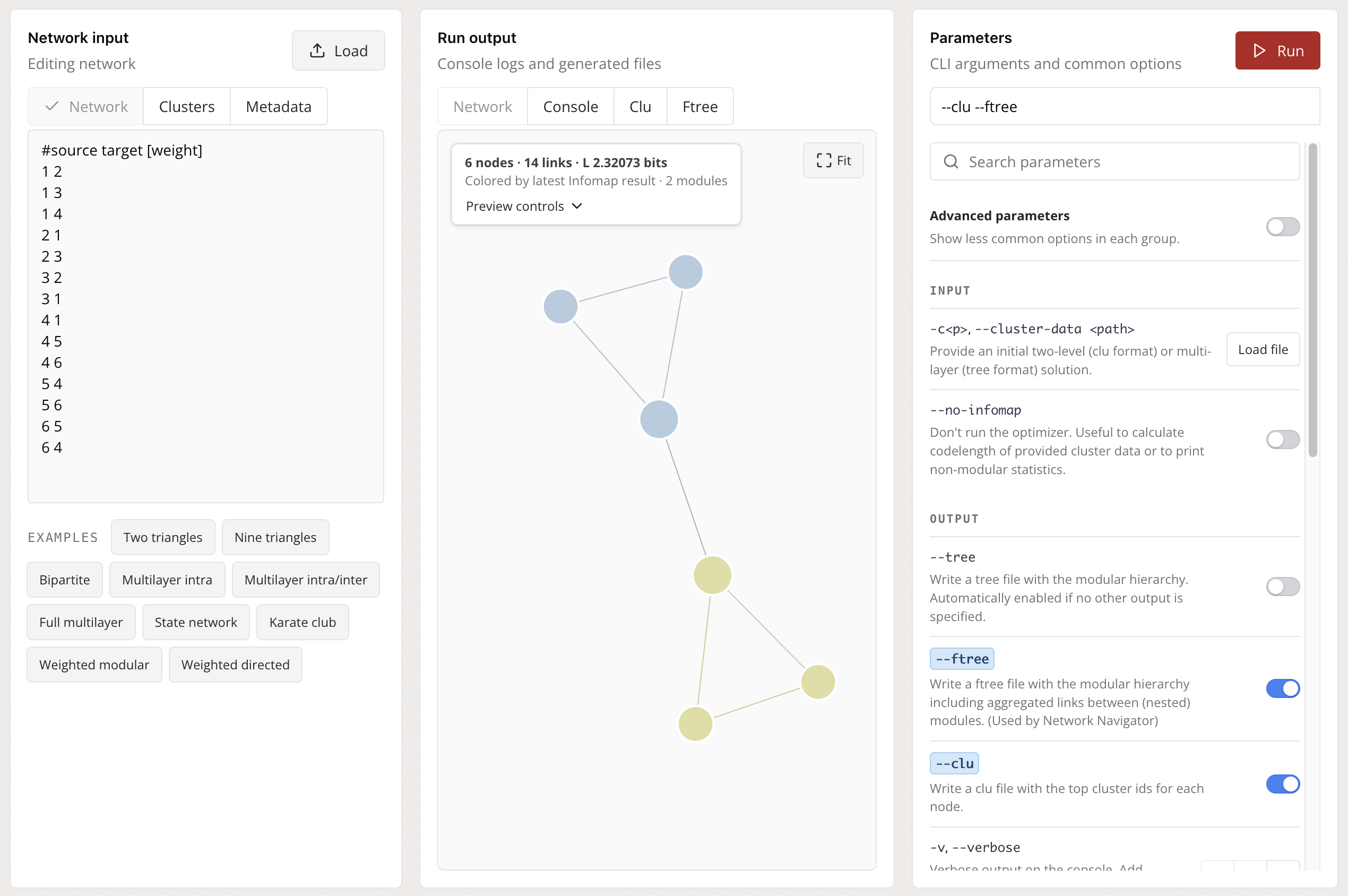
Network Navigator v2
Network Navigator is rebuilt on
d3gl and now shows raw or clustered networks
with millions of links in the browser. Open an Infomap .ftree result, or load
a raw network and cluster it with
Infomap without leaving the page. Choose a
plain or nested layout. The level of detail, based on the module hierarchy or on
spatial proximity, expands continuously as you zoom in. State networks can be
shown with physical nodes, state nodes, or both. Export the view as SVG or PNG,
or the result as .ftree
(GitHub).
Oct 15, 2026
C3 v2 – Consistent Categorical Colors
C3 generates distinct, deterministic categorical
colors for maps and charts. Version 2 places hues on the OKLCH hue circle or
along any d3 color scheme, and adds tones, seed colors, and nested colors for
hierarchies, with each child varying within its parent's range. It now comes in
TypeScript (npm install @mapequation/c3) and Python (pip install c3-colors)
with the same functions and the same colors, and has an interactive explorer
(changelog).
Jul 13, 2026
Infomap v2.15
infomap.run() is now the canonical, fully typed entry point for community
detection — common options live on the signature, and results come back as rich
Result objects with summary(), to_series(), and one-call to_networkx()
and to_igraph() conversions, plus a summary card that renders inline in
notebooks. Also new: bundled example networks in infomap.datasets, named state
nodes across the Python and R APIs, the infomap-network v1.0 JSON input format,
and exposed flow-iteration and tolerance controls. Options are now validated
with guided error messages, and engine logging routes through Python's standard
logging module (Python docs,
changelog).
Jun 25, 2026
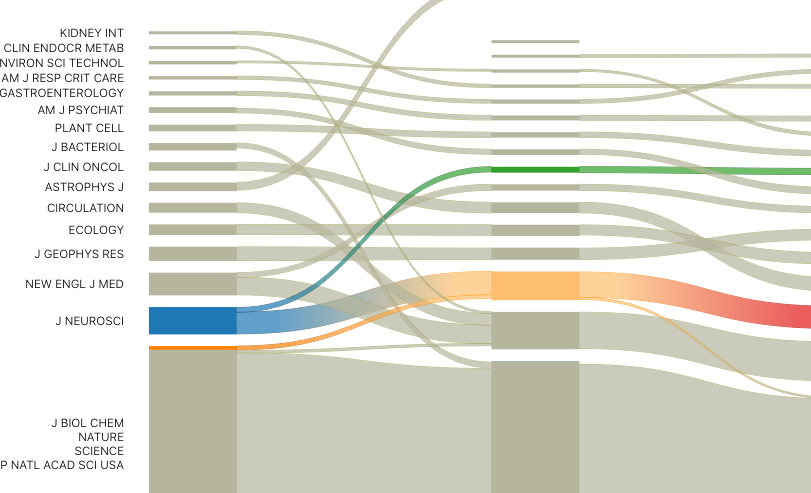
Map equation tutorial update
The map equation tutorial interactively explains the mechanics of the Map equation. In his master's thesis work, Henrik Larsson did a major update of the whole app and added missing sections explaining the hierarchical map equation and regularization for incomplete data.
Jun 23, 2026
Infomap v2.13
Stop trials on a codelength plateau with --converge, compact
--multilayer-relax-to-self coupling, multilayer cluster-data in the
Python/R API, cooperative interrupt hooks for long-running runs, and pretty
console output. Million-scale runs now use roughly half the peak memory and
finish about 25% faster than v2.12 with no loss in solution quality, and peak
memory is now largely independent of hierarchy depth — so deep hierarchical
networks are far cheaper to cluster
(changelog).
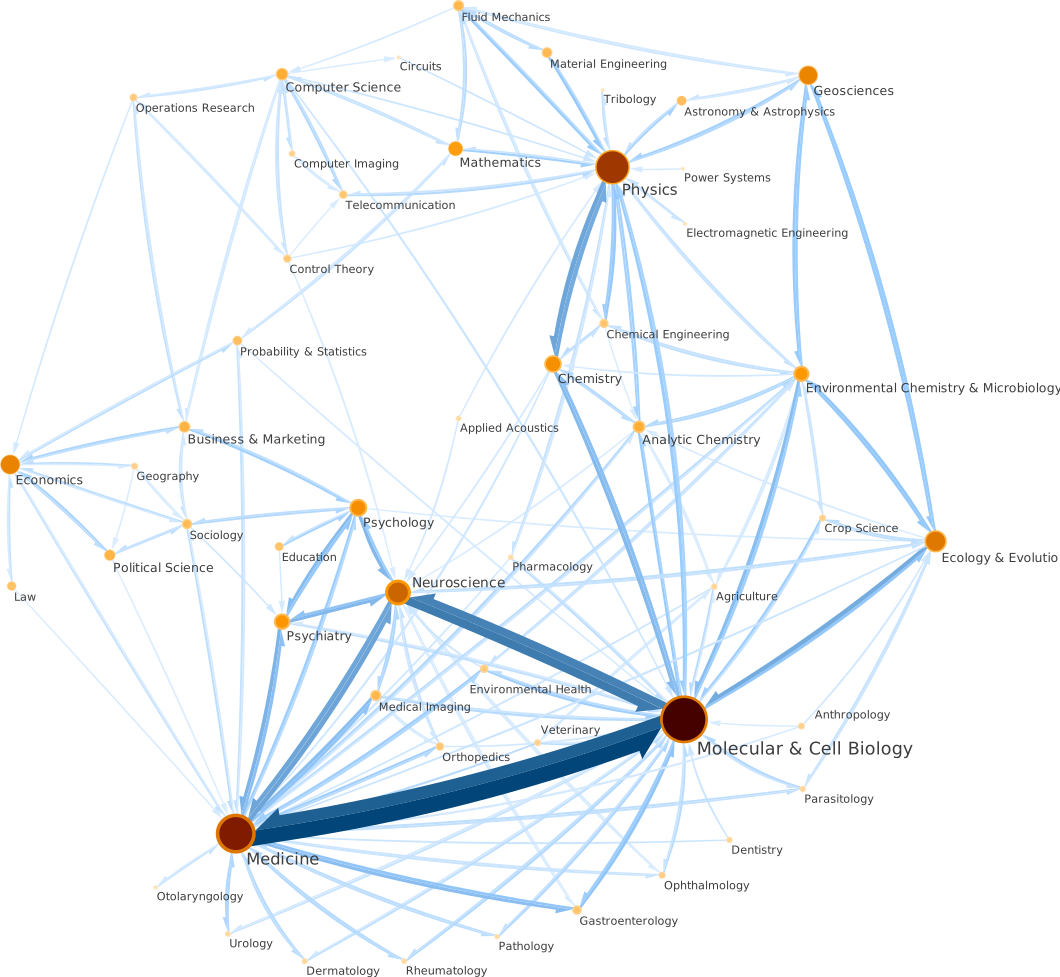
“The best maps convey a great deal of information but require minimal bandwidth: the best maps are also good compressions.”
M. Rosvall and C. T. Bergstrom, PNAS 105, 1118 (2008)